Showing posts with label 12v. Show all posts
Showing posts with label 12v. Show all posts
Friday, December 27, 2013
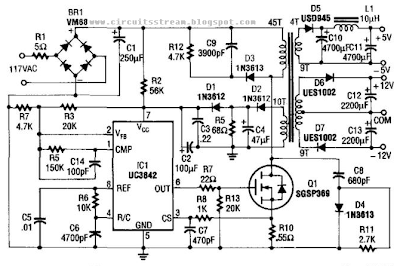
Build a 5v And 12V Ac Powered Switching Supply Circuit Diagram
How to Build a 5v And 12V Ac Powered Switching Supply Circuit Diagram? This supply uses an SGS-Thomson UC3842 IC in an off-line flyback regulator, providing + 5 V at 4 A and ± 12 V at 300 mA. This enables a small high-frequency (50 kHz) transformer, to handle large amounts of power that are normally handled by a 60-Hz transformer.
Q1 is a 5-A 500-V MOSFET, and the diodes are fast-recovery types. T1 has a 45-turn primary winding of #26 wire. The 12-V windings are each 9 turns of #30 wire, bifilar wound. The 5-V winding is 4 turns of four bifilar #26 wires. The control (feedback) winding is two bifilar, parallel 10-turn, #30 windings. The core is Ferroxcube EC35-3C8 with a 3/s` center leg.
5v And 12V Ac Powered Switching Supply Circuit Diagram

Tuesday, September 10, 2013
12V to 20V Automotive Power Converter
12V to +-20V Automotive Power Converter Diagram

The limitation of car supply voltage (12V) forces to convert the voltages to higher in order to power audio amplifiers. In fact the max audio power x speaker (with 4 ohm impedance) using 12V is (Vsupply+ - Vsupply-)^2/(8*impedance) 12^2/32 = 4.5Watts per channel, that is laughable... For powering correctly an amplifier the best is to use a symmetric supply with a high voltage differential. for example +20 - -20 = 40Volts in fact 40^2/32 = 50 Watts per channel that is respectable. This supply is intended for two channels with 50W max each (of course it depends on the amplifier used). Though it can be easily scaled up or the voltages changed to obtain different values.
Tuesday, April 2, 2013
5V to 12V Boost Converter Using LT1370
This is a design for booster converter. This booster can convert the voltage from 5 V to 12 V. This circuit is using LT1370 IC as main control. The high 6A switch rating permits the circuit to deliver up to 24W. This is the figure of the circuit.

The inductor needs to be chosen carefully to meet peak current values. The output capacitor can see high ripple currents often, as in this application, higher than the ripple rating of a single capacitor. This requires the use of two surfaces mount tantalums in parallel; both capacitors should be of the same value and manufacturer. The input capacitor does not have to endure such high ripple currents and a single capacitor will normally suffice. The catch diode, D1, must be rated for the output voltage and average output current. The compensation capacitor, C2, normally forms a pole in the 2Hz to 20Hz range, with a series resistor, R3, to add a zero at 1kHz to 5kHz. The S/S pin in this example is driven by a logical on/off signal, a low input forcing the LT1370 into its 12mA shutdown mode.
The inductor needs to be chosen carefully to meet peak current values. The output capacitor can see high ripple currents often, as in this application, higher than the ripple rating of a single capacitor. This requires the use of two surfaces mount tantalums in parallel; both capacitors should be of the same value and manufacturer. The input capacitor does not have to endure such high ripple currents and a single capacitor will normally suffice. The catch diode, D1, must be rated for the output voltage and average output current. The compensation capacitor, C2, normally forms a pole in the 2Hz to 20Hz range, with a series resistor, R3, to add a zero at 1kHz to 5kHz. The S/S pin in this example is driven by a logical on/off signal, a low input forcing the LT1370 into its 12mA shutdown mode.
12V to 220V converter circuit
This DIY 12V to 220V voltage converter is build with CMOS 4047 that is the main component of this small voltage converter that transforms a 12V DC into 220V AC. 4047 is used as a astable mutivibrator, at pins 10 and 11 will have a symmetrical rectangular signal wich is amplified b 2 Darlington transistors and finally reach the secondary coil of mains transformer ( 2x10V / 60VA ).

At the main voltage converter transformer terminals it will be 220V. With the help of P1 the output frequency can be adjusted between 50Hz to 400Hz. Although this is not part of any professional dc ac converters it can be used quite effective on some home appliances.
For more DC to AC voltage converters check the related posts.
Check out the tags for more 12 Volts to 220 Volts converters.
source [link]
Subscribe to:
Posts (Atom)