Showing posts with label lights. Show all posts
Showing posts with label lights. Show all posts
Monday, April 8, 2013
Sound Activated Lights
This diy sound activated lights circuit turns a lamp ON for a short duration when the dog barks (or a relatively strong sound) giving an impression that the occupants have been alerted. The condenser microphone fitted in a place to monitor sound and generates AC signals, which pass through DC blocking capacitor C1 to the base of transistor BC549 (T1). Transistor T1 along with transistor T2 amplifies the sound signals and provides current pulses from the collector of T2. When sound is produced in front of the condenser mic, triac1 (BT136) fires, activates lights and the bulb (B1) glows for about two minutes.

Assemble the sound activated lights circuit on a general purpose PCB (circuit board) and enclose in a plastic cabinet. Power to the sound activated switch circuit can be derived from a 12V, 500mA step-down transformer with rectifier and smoothing capacitor. Solder the triac ensuring sufficient spacing between the pins to avoid short circuit. Fix the unit in the dog’s cage or close to the sound monitoring spot, with the lamp inside or outside as desired. Connect the microphone to the sount activated lights circuit using a short length of shielded wire. Enclose the microphone in a tube to increase its sensitivity.
Caution. Since the sound activated lights uses 230V AC, many of its points are at AC mains voltage. It could give you lethal shock if you are not careful. So if you don’t know much about working with line voltages, do not attempt to construct this circuit. We will not be responsible for any kind of resulting loss or damage.

Thursday, April 4, 2013
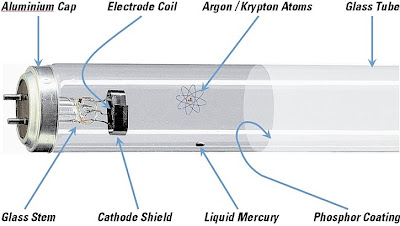
Fluorescent lamp lights starter
Why fluorescent lamp light blinking before long? Because Fluorescent light removes electrons and hit the wall of a glass tube coated with phosphors that emit light plastic. To throw a flow of electrons in the metal out in need of very high voltage electricity. Because not enough to voltage that we use 220 volt, fluorescent lamp starter, grafted on to stop a while to produce electricity in a high electric voltage.
 |
| Fluorescent light starter components |
High-voltage electric is cutt off from current to flow. Therefore, when Fluorescent Lamps, electrical connecting repeatedly cut, so look at our eyes blink, while starter is generally light but, when the lights go out starter that is lit exactly goes on.
Subscribe to:
Posts (Atom)